Cross-Condition Analysis#
Packages#
Note: To run this analysis you will need to install ParTIpy with the tutorial extras: pip install partipy[extra].
from pathlib import Path

import plotnine as pn
import scanpy as sc
import partipy as pt

import numpy as np
import pandas as pd
from scipy.spatial import ConvexHull
from scipy.spatial.distance import cdist
from statsmodels.stats.multitest import multipletests
from mizani.bounds import squish
import decoupler as dc
import scipy.cluster.hierarchy as sch
from scipy.spatial.distance import pdist
from scipy.stats import ttest_ind
from scipy.optimize import linear_sum_assignment
adata.obsm["X_pca_harmony"]
Motivation#
Cross-condition analyses are a central component of single-cell transcriptomic studies and are commonly performed by discretizing cells into clusters followed by tests for condition-dependent changes in cluster abundance or gene expression. While effective in many settings, such approaches impose sharp boundaries on cell states that are often intrinsically continuous. ParTIpy enables an alternative formulation by modeling cells as continuous mixtures of archetypal programs (“tasks”), thereby enabling the testing of shifts within the task space across conditions.
Data#
To illustrate this workflow, we will analyize single-nucleus RNA-seq data from human adult heart tissue comprising 16 non-failing (NF) donor hearts and 26 cardiomyopathy (CM; pooled hypertrophic and dilated cardiomyopathy) hearts, focusing on approximately 147,000 fibroblasts from [CPS+22].
Fibroblasts are particularly well suited for this analysis, as they exhibit pronounced disease-associated transcriptional remodeling and span a continuum from quiescent ECM maintenance to activated, fibrotic programs in cardiomyopathy.
The adata object must be manually downloaded from: https://singlecell.broadinstitute.org/single_cell/study/SCP1303/single-nuclei-profiling-of-human-dilated-and-hypertrophic-cardiomyopathy#study-download
adata = sc.read_h5ad(Path("data") / "human_dcm_hcm_scportal_03.17.2022.h5ad")

# 1) subset to fibroblasts
adata = adata[
    adata.obs["cell_type_leiden0.6"].isin(["Fibroblast_I", "Activated_fibroblast", "Fibroblast_II"]),
    :,
].copy()

# 2) map HCM and DCM to CM
adata.obs["disease_original"] = adata.obs["disease"].copy()
adata.obs["disease"] = adata.obs["disease_original"].map({"HCM": "CM", "DCM": "CM", "NF": "NF"})

# 3) define color dict for plotting later
color_dict = {
    "NF": "#01665E",
    "CM": "#8C510A",
}

# 4) check that data has counts
assert np.all(np.isclose(adata.X.data, np.round(adata.X.data)))

# 5) save some memory
if "cellranger_raw" in adata.layers:
    del adata.layers["cellranger_raw"]
if "X_umap" in adata.obsm:
    del adata.obsm["X_umap"]

adata
AnnData object with n_obs × n_vars = 147219 × 36601
    obs: 'biosample_id', 'donor_id', 'disease', 'sex', 'age', 'lvef', 'cell_type_leiden0.6', 'SubCluster', 'cellbender_ncount', 'cellbender_ngenes', 'cellranger_percent_mito', 'exon_prop', 'cellbender_entropy', 'cellranger_doublet_scores', 'disease_original'
    var: 'gene_ids', 'feature_types', 'genome'
Preprocessing#
Before downstream analysis, we perform standard single-cell RNA-seq quality control.
We first annotate mitochondrial (MT-), ribosomal (RPS, RPL), and hemoglobin (HB) genes and compute canonical QC metrics using scanpy.pp.calculate_qc_metrics, including:
total counts per cell
number of detected genes per cell
percentage of counts attributed to mitochondrial, ribosomal, and hemoglobin genes
number of cells expressing each gene
Cells with low library size, low gene complexity, or excessive mitochondrial content are filtered. Genes detected in too few cells are removed.
This ensures that subsequent analyses are not driven by low-quality cells or uninformative genes.
# 1) add bool vector that indicate mitochondrial, ribosomal, and hemoglobin related genes
adata.var["mt"] = adata.var_names.str.startswith("MT-")
adata.var["ribo"] = adata.var_names.str.startswith(("RPS", "RPL"))
adata.var["hb"] = adata.var_names.str.contains("^HB[^(P)]")

# 2) compute canonical QC metrics
sc.pp.calculate_qc_metrics(adata, qc_vars=["mt", "ribo", "hb"], inplace=True, percent_top=[20], log1p=False)
adata.var["log10_n_cells_by_counts"] = np.log10(adata.var["n_cells_by_counts"])
adata.obs["log10_total_counts"] = np.log10(adata.obs["total_counts"])
adata.obs["log10_n_genes_by_counts"] = np.log10(adata.obs["n_genes_by_counts"])

# 3) visualization
qc_vars = ["log10_total_counts", "log10_n_genes_by_counts", "pct_counts_mt", "pct_counts_ribo", "pct_counts_hb"]
plot_df = pd.concat(
    [
        adata.obs.melt(id_vars=["disease"], value_vars=qc_vars),
        adata.var.melt(value_vars=["log10_n_cells_by_counts"]).assign(disease="NA"),
    ]
)
p = (
    pn.ggplot(plot_df)
    + pn.geom_violin(pn.aes(x="variable", y="value", fill="disease"))
    + pn.facet_wrap("variable", nrow=6, scales="free")
    + pn.scale_fill_manual(values=color_dict)
    + pn.theme(figure_size=(4, 5))
    + pn.coord_flip()
    + pn.labs(x="", y="")
)
p.show()
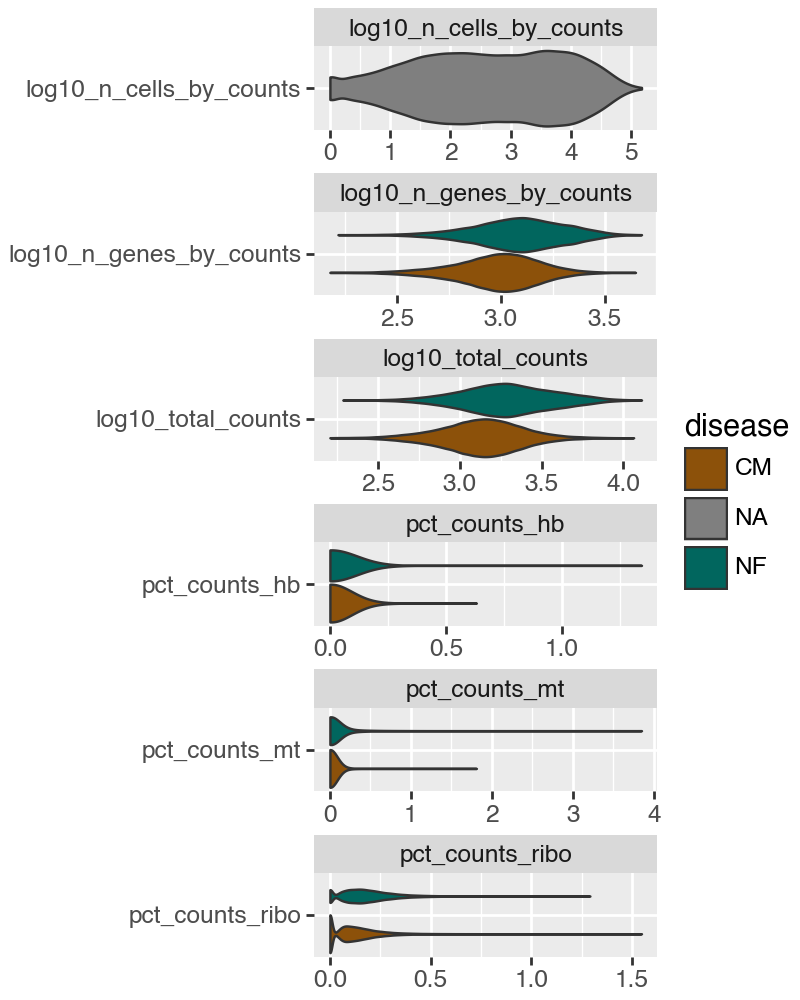
Based on the above plot, we set the following (conservative) QC thresholds:
Cells: retain cells with total_counts ≥ 300 and with low fractions of mitochondrial, ribosomal, and hemoglobin counts (pct_counts_mt, pct_counts_ribo, pct_counts_hb ≤ 0.5).
Genes: retain genes detected in at least 200 cells (n_cells_by_counts ≥ 200).
# 1) set the thresholds
min_counts_per_cell = 300
min_cells_per_gene = 200
max_pct_count_hb = 0.5
max_pct_count_mt = 0.5
max_pct_count_ribo = 0.5

# 2) filter cells
adata = adata[adata.obs["total_counts"] >= min_counts_per_cell, :].copy()
adata = adata[adata.obs["pct_counts_hb"] <= max_pct_count_hb, :].copy()
adata = adata[adata.obs["pct_counts_mt"] <= max_pct_count_mt, :].copy()
adata = adata[adata.obs["pct_counts_ribo"] <= max_pct_count_ribo, :].copy()

# 3) filter genes
adata = adata[:, adata.var["n_cells_by_counts"] >= min_cells_per_gene].copy()

# 4) check
plot_df = pd.concat(
    [
        adata.obs.melt(id_vars=["disease"], value_vars=qc_vars),
        adata.var.melt(value_vars=["log10_n_cells_by_counts"]).assign(disease="NA"),
    ]
)
p = (
    pn.ggplot(plot_df)
    + pn.geom_violin(pn.aes(x="variable", y="value", fill="disease"))
    + pn.facet_wrap("variable", nrow=6, scales="free")
    + pn.scale_fill_manual(values=color_dict)
    + pn.theme(figure_size=(4, 5))
    + pn.coord_flip()
    + pn.labs(x="", y="")
)
p.show()

print(adata)
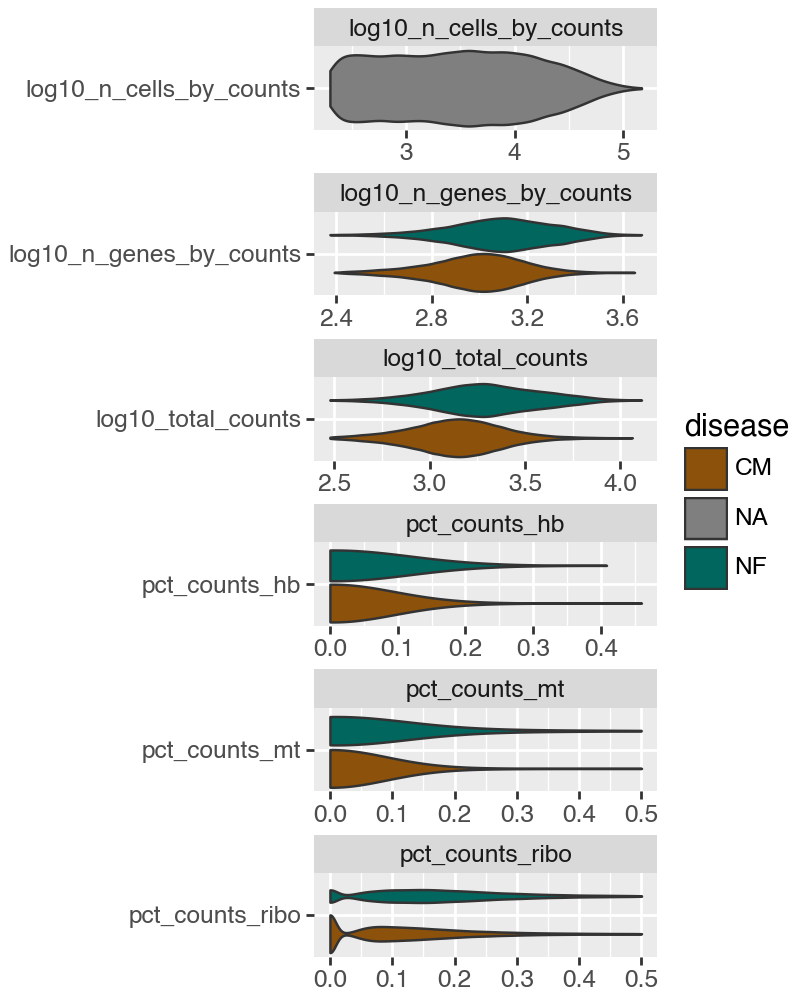
AnnData object with n_obs × n_vars = 142801 × 18866
    obs: 'biosample_id', 'donor_id', 'disease', 'sex', 'age', 'lvef', 'cell_type_leiden0.6', 'SubCluster', 'cellbender_ncount', 'cellbender_ngenes', 'cellranger_percent_mito', 'exon_prop', 'cellbender_entropy', 'cellranger_doublet_scores', 'disease_original', 'n_genes_by_counts', 'total_counts', 'pct_counts_in_top_20_genes', 'total_counts_mt', 'pct_counts_mt', 'total_counts_ribo', 'pct_counts_ribo', 'total_counts_hb', 'pct_counts_hb', 'log10_total_counts', 'log10_n_genes_by_counts'
    var: 'gene_ids', 'feature_types', 'genome', 'mt', 'ribo', 'hb', 'n_cells_by_counts', 'mean_counts', 'pct_dropout_by_counts', 'total_counts', 'log10_n_cells_by_counts'
Before conducting archetypal analysis (AA), we reduce the dimensionality of the scRNA-seq data to suppress technical noise and improve computational efficiency. We first normalize each cell to a common library size using sc.pp.normalize_total, followed by log-transformation with sc.pp.log1p. By default, normalize_total scales each cell to the median total counts across all cells, preserving a typical pre-log expression range.
Next, we select highly variable genes (HVGs) and compute a low-dimensional representation via PCA on HVGs only (here, 50 PCs).
For downstream archetype characterization, we additionally compute a capped z-score transformation (max_value=10). This facilitates interpretable aggregation and enrichment analyses at the archetype level. However, storing z-scored expression requires materializing a dense cells × genes matrix, which can be memory-intensive for large datasets.
As a memory-efficient alternative, one can omit storing z-scores and instead use pt.compute_quantile_based_gene_enrichment for archetype characterization, which identifies genes enriched near each archetype without requiring a dense matrix. The trade-off is computational time, as the quantile-based procedure is substantially slower.
sc.pp.normalize_total(adata)
sc.pp.log1p(adata)
sc.pp.highly_variable_genes(adata)
sc.pp.pca(adata, mask_var="highly_variable", n_comps=50)
adata.layers["z_scaled"] = sc.pp.scale(adata.X, max_value=10).astype(np.float32)
assert adata.layers["z_scaled"].dtype == np.float32
Furthermore, to account for inter-patient variation, we integrate the data across donors using Harmony. Specifically, we apply Harmony to the PCA embedding with donor_id as the batch variable and store the corrected embedding for downstream analyses.
Harmony is stochastic, so results are not perfectly reproducible across runs (due to using sklearn.cluster.KMeans). For this tutorial, we use a cached Harmony embedding to keep outputs stable. Small run-to-run differences do not change archetype positions, but they can permute archetype labels because the solution is only identifiable up to permutation.
#import random
#random.seed(42)
#np.random.seed(42)
#import harmonypy as hm
#ho = hm.run_harmony(adata.obsm["X_pca"], adata.obs[["donor_id"]], "donor_id", verbose=False, random_state=0, device="cpu")
#np.save("data/X_pca_harmony.npy", ho.Z_corr)
#del ho

adata.obsm["X_pca_harmony"] = np.load("data/X_pca_harmony.npy")
adata.obsm["X_pca_harmony"][:4, :4]
array([[ 1.3877512 , -0.69327146, -0.5261209 ,  0.94981146],
       [ 2.891818  , -0.07821041, -0.37263605,  0.45093182],
       [ 2.1957715 , -2.2278605 , -0.69618624, -0.21003814],
       [ 1.058967  , -3.083737  , -3.1326694 , -2.1296427 ]],
      dtype=float32)
Now, To determine the number of principal components to use for fitting the archetypes, we will examine the scree plot from the PCA. Additionally the plot shows the variance explained if we shuffle the data before computing the PCA.
Here, the plot indicates that we should only the first 16 principal components.
pt.compute_shuffled_pca(adata, mask_var="highly_variable", n_shuffle=25)
p = pt.plot_shuffled_pca(adata) + pn.theme_bw()
p.show()
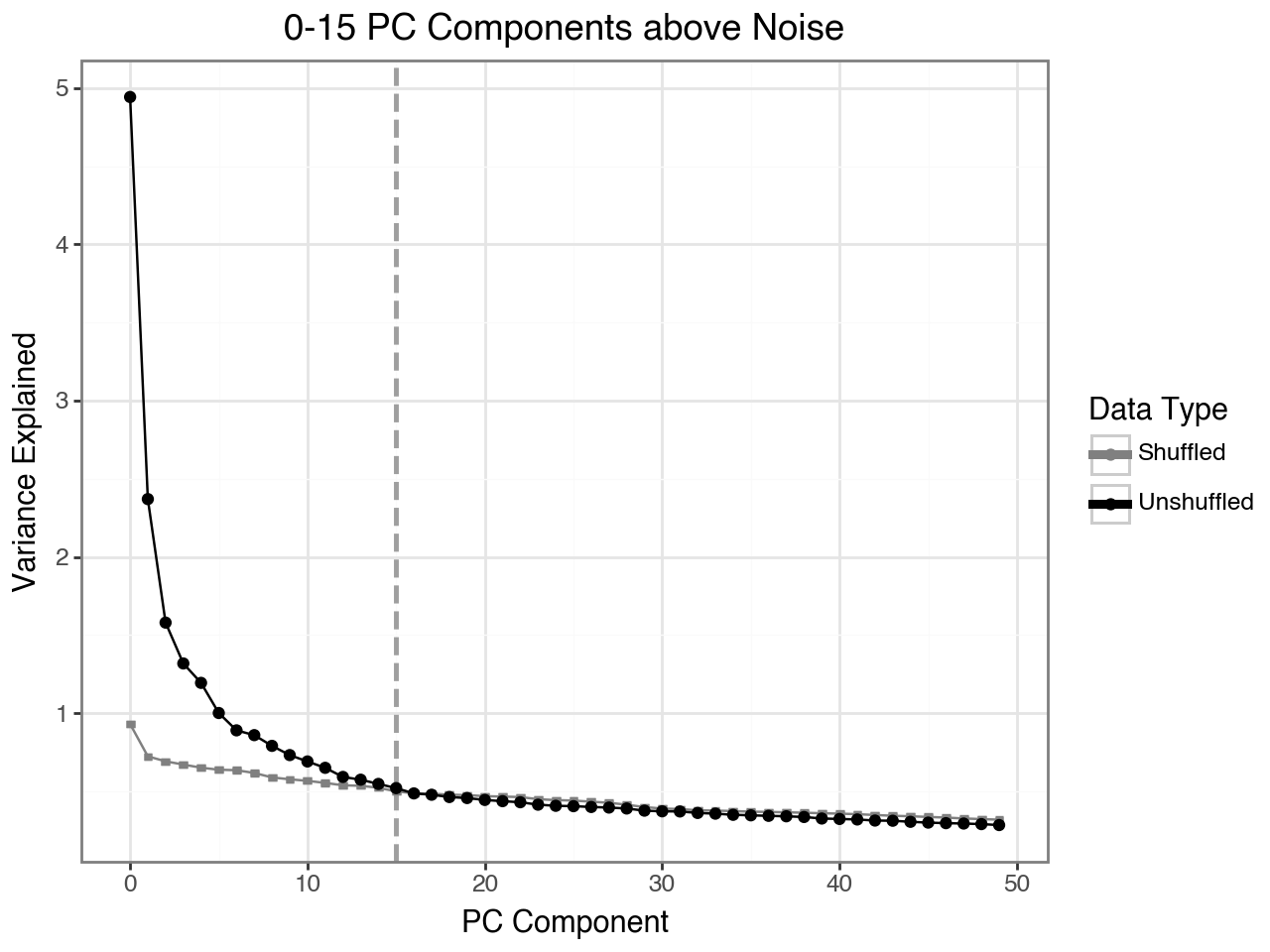
Based on the above results, we retain the first 16 principal components. Importantly, we explicitly specify that archetypal analysis should be performed on the Harmony-corrected PCA embedding, stored under the obsm_key X_pca_harmony.
pt.set_obsm(adata=adata, obsm_key="X_pca_harmony", n_dimensions=16)
Choosing the Number of Archetypes#
Now, we are ready to perform archetypal analysis, but the key question remains: how many archetypes should be used?
There is no definitive ground truth for this choice, but several heuristics can guide the decision. A practical approach is to evaluate selection metrics across a range of archetype counts.
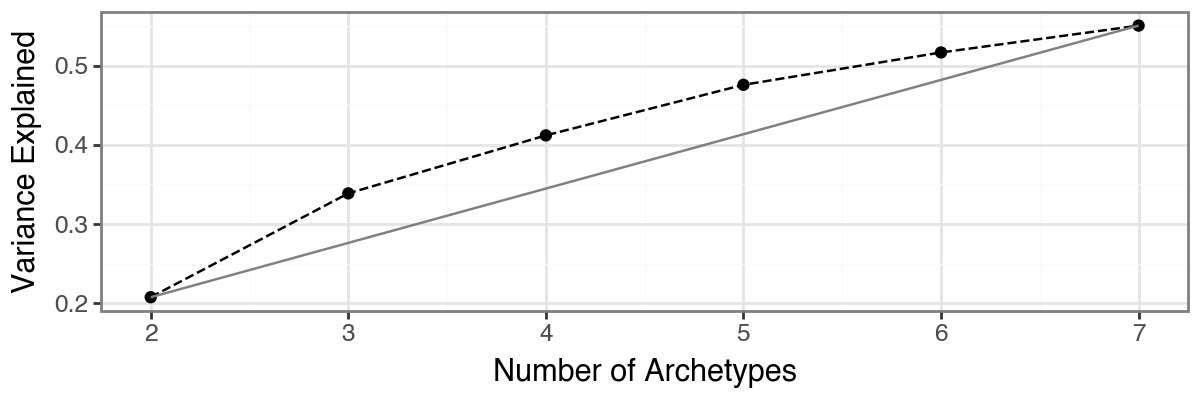
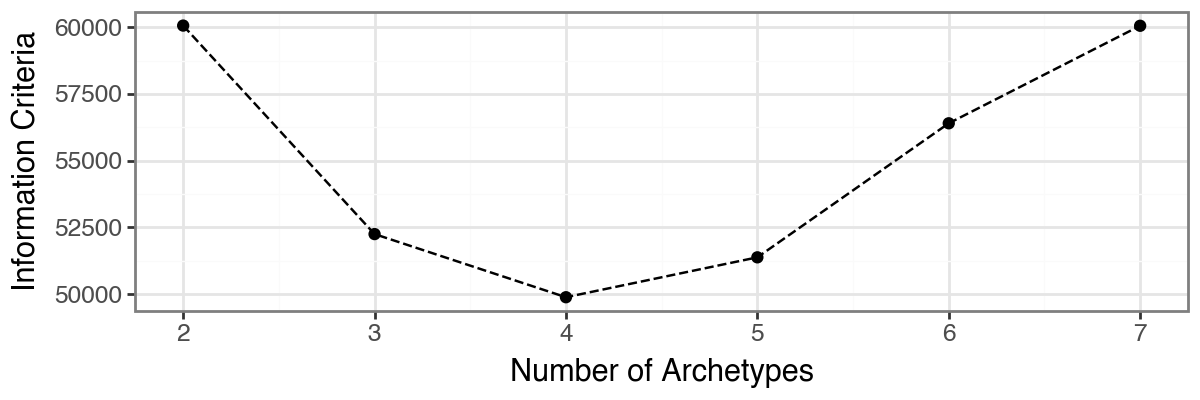
The function pt.compute_selection_metrics() evaluates multiple values of k (here via n_archetypes_list=range(2, 8)) and computes both variance explained and an information criterion suggested by [Sul17].
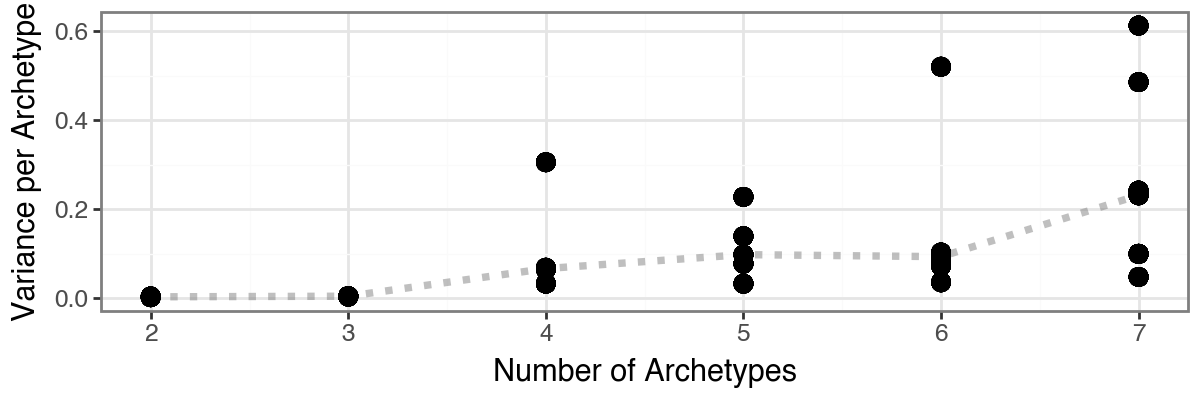
The results are cached in adata.uns["AA_selection_metrics"] and can be visualized with pt.plot_var_explained(adata) and pt.plot_IC(adata). In this example, both diagnostics suggest that choosing 4 archetypes is a reasonable trade-off, since additional variance explained beyond this point is small.
pt.compute_selection_metrics(
    adata=adata, n_archetypes_list=range(2, 8), coreset_algorithm="standard", coreset_fraction=0.05
)
pt.compute_bootstrap_variance(
    adata=adata,
    n_bootstrap=50,
    n_archetypes_list=range(2, 8),
    coreset_algorithm="standard",
    coreset_fraction=0.05,
)

p = pt.plot_var_explained(adata) + pn.theme_bw() + pn.theme(figure_size=(6, 2)) + pn.labs(x="Number of Archetypes")
p.show()

p = pt.plot_IC(adata) + pn.theme_bw() + pn.theme(figure_size=(6, 2)) + pn.labs(x="Number of Archetypes")
p.show()

p = pt.plot_bootstrap_variance(adata) + pn.theme_bw() + pn.theme(figure_size=(6, 2)) + pn.labs(x="Number of Archetypes")
p.show()
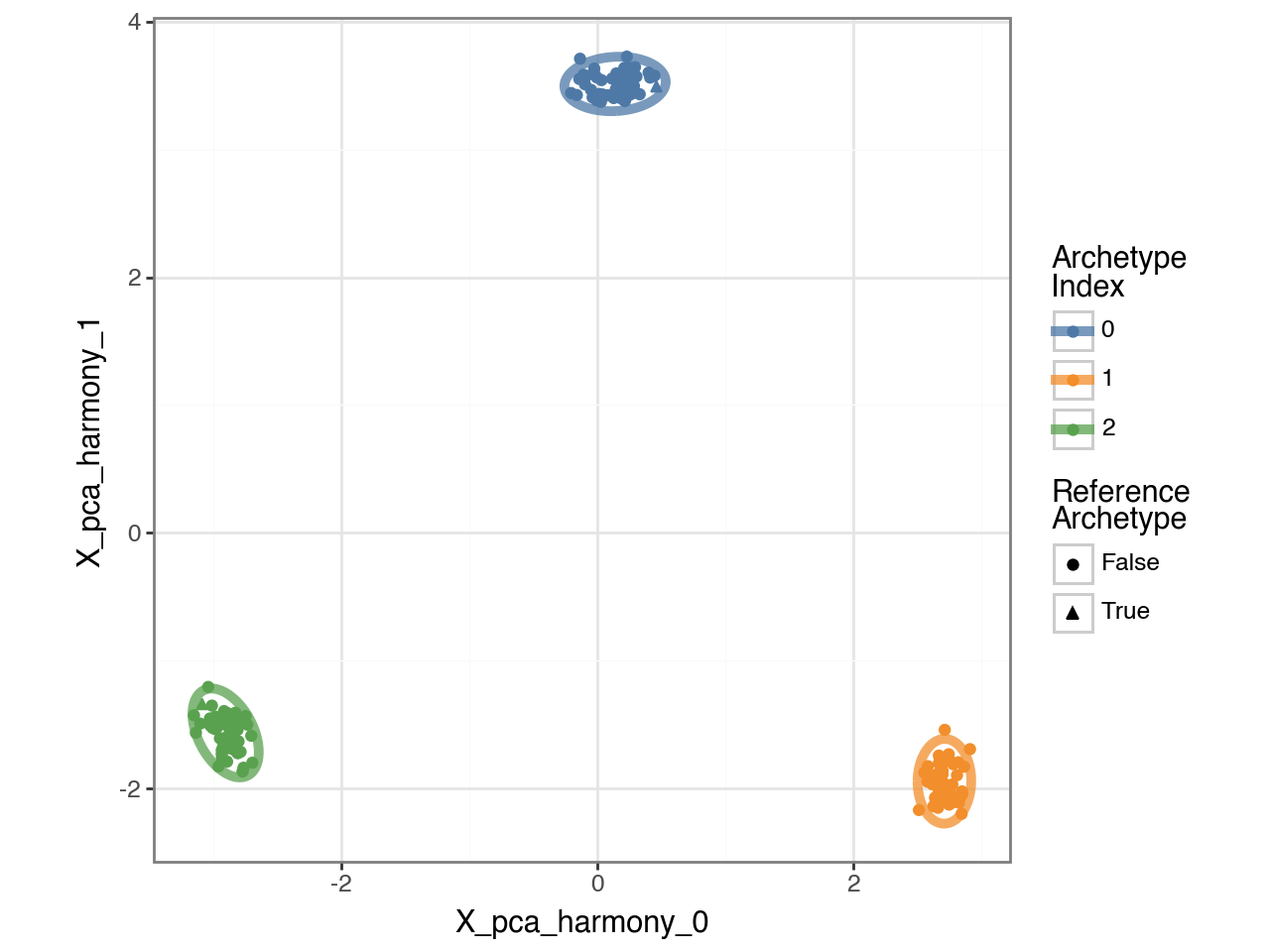
Based on the model selection results, we opt for three archetypes.
Although both the proportion of variance explained and the information criterion favored a four-archetype solution, the four-archetype configuration exhibited one archetype with high positional variance across bootstrap replicates, indicating limited robustness. In contrast, the three-archetype model showed slightly reduced reconstruction performance but substantially improved bootstrap stability and reproducibility. This trade-off favors a more robust and biologically interpretable representation of the data.
n_archetypes = 3
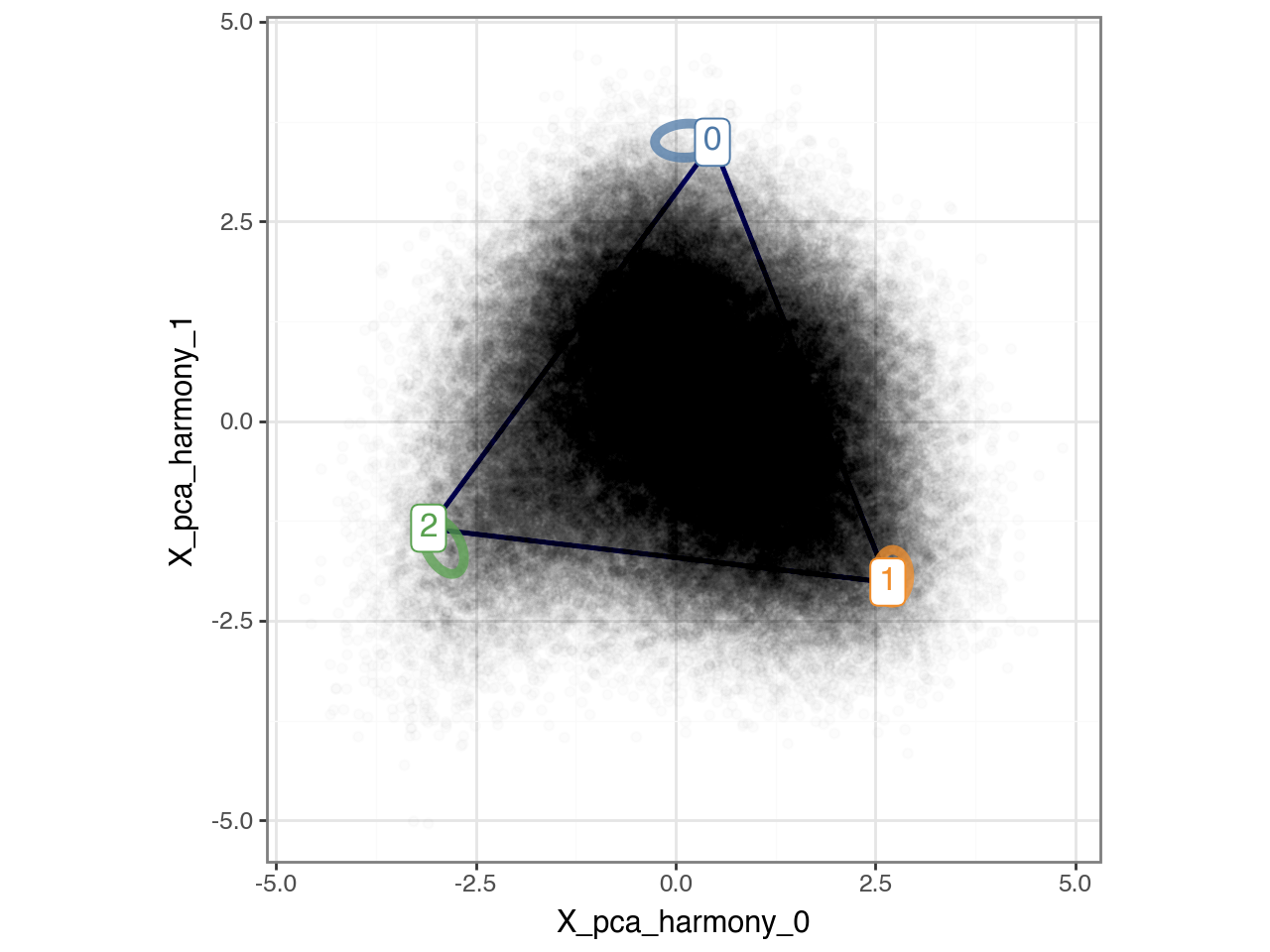
Below, we visualize the inferred archetypes projected onto the first two Harmony-corrected principal components. Note, however, that the archetypes were fitted in the full 16-dimensional embedding; the two-dimensional plot is shown purely for visualization purposes.
p = (
    pt.plot_archetypes_2D(
        adata=adata,
        show_contours=True,
        result_filters={"n_archetypes": n_archetypes},
        alpha=0.01,
    )
    + pn.theme_bw()
)
p.show()
p = pt.plot_bootstrap_2D(adata, result_filters={"n_archetypes": n_archetypes}) + pn.theme_bw()
p.show()
Cross-Condition Contrast#
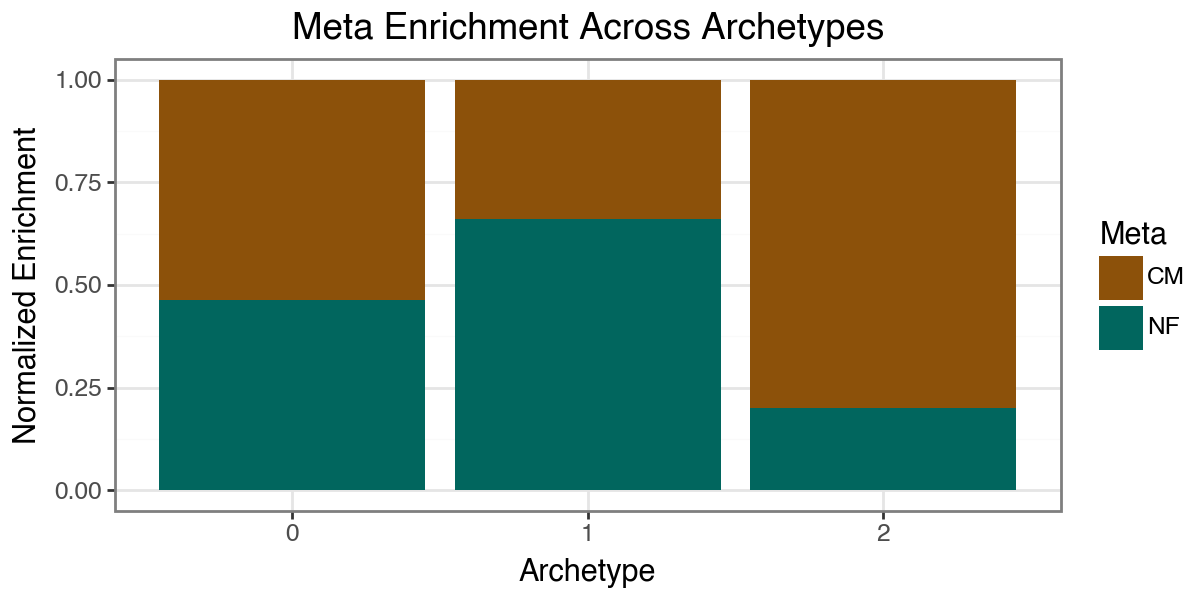
We can gauge condition enrichment near each archetype using pt.compute_meta_enrichment. This computes, for each archetype k, the relative concentration of cells from each condition (here: disease) among cells with high archetype weights, and visualizes the result as a barplot.
pt.compute_archetype_weights(adata=adata, mode="automatic", result_filters={"n_archetypes": n_archetypes})

disease_enrichment = pt.compute_meta_enrichment(
    adata=adata, meta_col="disease", result_filters={"n_archetypes": n_archetypes}
)
p = pt.barplot_meta_enrichment(disease_enrichment, color_map=color_dict) + pn.theme_bw() + pn.theme(figure_size=(6, 3))
p.show()
Applied length scale is 1.77.
To avoid pseudo-replication and ensure valid statistical inference, we quantify shifts in task allocation at the donor level rather than at the single-cell level.
Let \(\mathbf{X} \in \mathbb{R}^{N \times D}\) denote the Harmony-corrected PCA embedding used for archetype inference (with \(D=16\) in this analysis), and let \(\mathbf{Z} \in \mathbb{R}^{K \times D}\) denote the learned archetype matrix.
1. Donor-level aggregation
Let \(\mathcal{I}_d \subset \{1,\dots,N\}\) denote the index set of fibroblast cells originating from donor \(d\), and let \(n_d = |\mathcal{I}_d|\).
We compute the donor-level mean embedding
This yields one low-dimensional representation per donor, summarizing the average fibroblast task allocation.
2. Projection onto the archetypal simplex
For each donor \(d\), we estimate donor-level archetype weights \(\boldsymbol{\alpha}_d \in \Delta_{K-1}\) by solving
where \(\Delta_{K-1}\) denotes the standard \((K-1)\)-simplex.
The corresponding reconstruction is
Thus, \(\boldsymbol{\alpha}_d\) represents the mean donor-level task allocation in archetypal coordinates.
3. Donor-level proximity to archetypes
For each donor \(d\) and archetype \(k \in \{1,\dots,K\}\), we compute the Euclidean distance between the reconstructed donor embedding and archetype \(k\):
The matrix \(\mathbf{D} \in \mathbb{R}^{D_{\text{donor}} \times K}\) therefore quantifies donor-level proximity to each task-specialized state.
4. Statistical comparison across conditions
Let \(\mathcal{D}_{\mathrm{CM}}\) and \(\mathcal{D}_{\mathrm{NF}}\) denote the sets of cardiomyopathy (CM) and non-failing (NF) donors, respectively.
For each archetype \(k\), we compare \(\{D_{dk}\}_{d \in \mathcal{D}_{\mathrm{CM}}}\) and \(\{D_{dk}\}_{d \in \mathcal{D}_{\mathrm{NF}}}\) using a two-sided Welch’s \(t\)-test, which does not assume equal variances between groups.
Multiple testing across archetypes is controlled using the Benjamini–Hochberg procedure to control the false discovery rate.
# 1) get the archetypes
aa_results_dict = pt.get_aa_result(adata, n_archetypes=n_archetypes)
Z = aa_results_dict["Z"].copy().astype(np.float32)
archetype_df = pd.DataFrame(Z, columns=[f"pc_{arch_idx}" for arch_idx in range(Z.shape[1])])
archetype_df["archetype"] = [f"{idx}" for idx in range(len(archetype_df))]

# 2) get the single-cell data (note adata.uns["AA_config"]["n_dimensions"] is a list of ints)
X = adata.obsm[adata.uns["AA_config"]["obsm_key"]][:, adata.uns["AA_config"]["n_dimensions"]].copy().astype(np.float32)

# 3) aggregate per patient
cols_to_check = ["disease"] + ["donor_id"]
nuniq = adata.obs.groupby("donor_id")[cols_to_check].nunique(dropna=False)
assert (nuniq.max() <= 1).all(), f"Non-unique covariates within sample_id:\n{nuniq.max()[nuniq.max() > 1]}"
obs_agg = adata.obs[cols_to_check].drop_duplicates().copy()
X_agg = np.zeros((len(obs_agg), X.shape[1]), dtype=np.float32)
for idx, smp_id in enumerate(obs_agg["donor_id"]):
    X_agg[idx, :] = X[adata.obs["donor_id"] == smp_id, :].mean(axis=0)

# 4) project onto the convex hull
AA_model = pt.AA(n_archetypes=len(Z))
AA_model.Z = Z
AA_model.n_samples = len(X_agg)
X_agg_proj = AA_model.transform(X_agg)
assert np.all(np.isclose(X_agg_proj.sum(axis=1), 1))
assert np.all(X_agg_proj >= 0)
X_agg_conv = X_agg_proj @ Z

# 5) add first 3 pcs to obs_agg for plotting
for pc_idx in [0, 1, 2]:
    obs_agg[f"pc_{pc_idx}"] = X_agg_conv[:, pc_idx]

# O) plotting
hull = ConvexHull(archetype_df[["pc_0", "pc_1"]].to_numpy())
hull_points = archetype_df.iloc[hull.vertices][["pc_0", "pc_1"]]
hull_df = pd.concat([hull_points, hull_points.iloc[:1]], ignore_index=True)
p = (
    (
        pn.ggplot()
        + pn.geom_point(data=obs_agg, mapping=pn.aes(x="pc_0", y="pc_1", color="disease"))
        + pn.geom_point(
            data=archetype_df,
            mapping=pn.aes(x="pc_0", y="pc_1"),
            color="grey",
            alpha=0.5,
            size=2,
        )
        + pn.geom_label(
            data=archetype_df,
            mapping=pn.aes(x="pc_0", y="pc_1", label="archetype"),
            color="black",
            fill="white",
            boxcolor="black",
            label_r=0.2,
            label_padding=0.2,
            label_size=0.7,
            size=20,
        )
    )
    + pn.theme_bw()
    + pn.guides(color=pn.guide_legend(override_aes={"alpha": 1.0, "size": 5}))
    + pn.scale_color_manual(values=color_dict)
    + pn.labs(x="PC 0", y="PC 1", color="Disease\nStatus")
    + pn.theme(
        legend_key=pn.element_rect(fill="white", color="white"),
        legend_background=pn.element_rect(fill="white", color="black"),
    )
)
p += pn.geom_path(
    data=hull_df,
    mapping=pn.aes(x="pc_0", y="pc_1"),
    color="grey",
    size=1.2,
    alpha=0.5,
)
p.show()
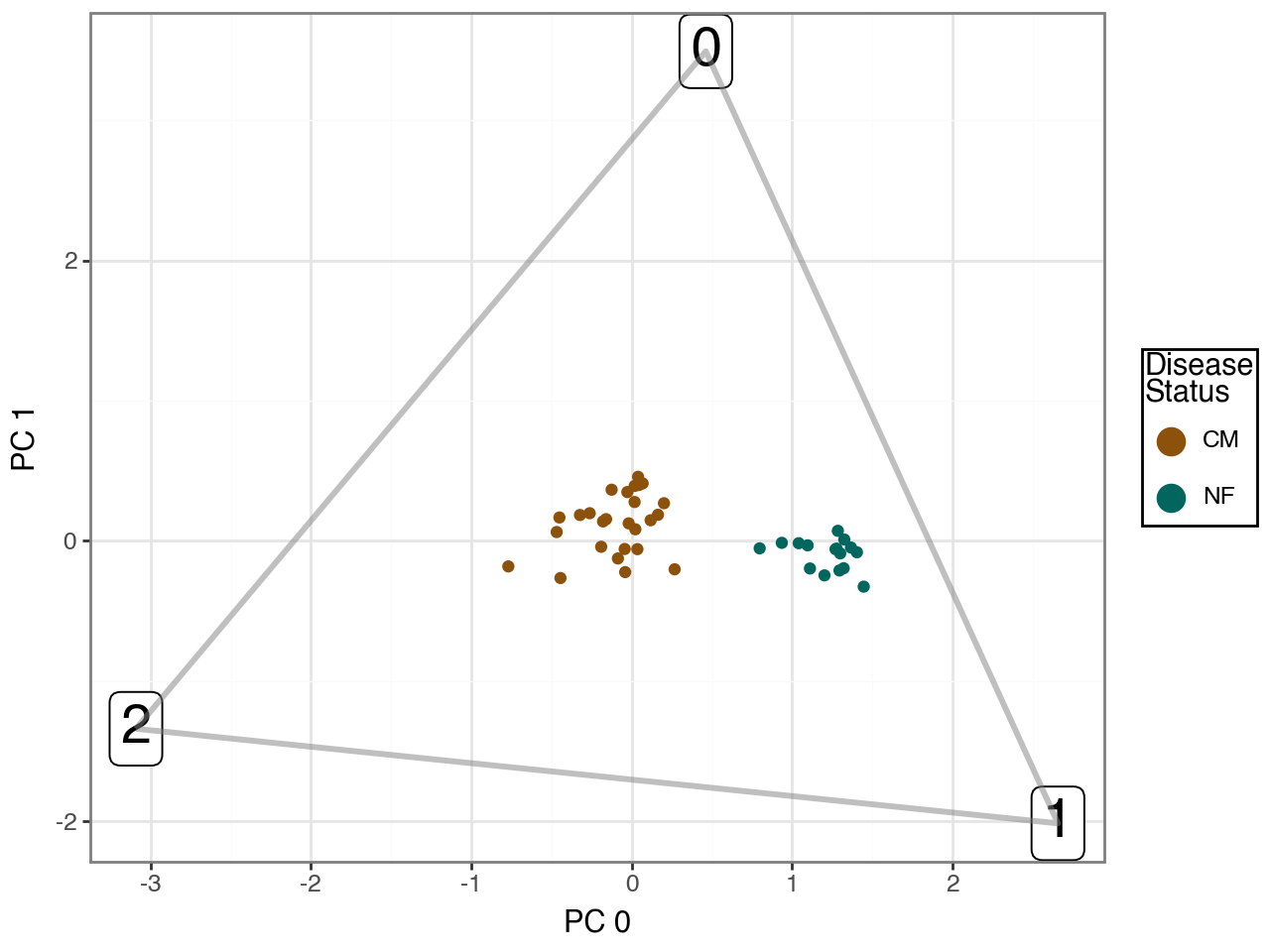
And, then we compute distances and perform statistical tests.
# 6) compute the distance matrix
dist_key = "euclidean"
D = cdist(XA=X_agg_conv, XB=Z, metric=dist_key)

# 7) add distance to the dataframe
for arch_idx in range(len(Z)):
    obs_agg[f"dist_to_arch_{arch_idx}"] = D[:, arch_idx]

# prepare for plotting
dist_cols = [c for c in obs_agg.columns if c.startswith("dist_to_arch_")]
plot_df = obs_agg.melt(id_vars=["donor_id", "disease"], value_vars=dist_cols)
plot_df["variable_clean"] = [s.replace("dist_to_arch_", "Archetype ") for s in plot_df["variable"]]

# Run Welch's t-test
dist_cols = [c for c in obs_agg.columns if c.startswith("dist_to_arch_")]
g0, g1 = "NF", "CM"

rows = []
for c in dist_cols:
    x = obs_agg.loc[obs_agg["disease"] == g0, c].astype(float).dropna().to_numpy()
    y = obs_agg.loc[obs_agg["disease"] == g1, c].astype(float).dropna().to_numpy()

    tstat, pval = ttest_ind(x, y, equal_var=False, nan_policy="omit")  # Welch

    rows.append(
        {
            "dist_col": c,
            "group0": g0,
            "group1": g1,
            "n0": x.size,
            "n1": y.size,
            "mean0": np.mean(x) if x.size else np.nan,
            "mean1": np.mean(y) if y.size else np.nan,
            "diff_mean_0_minus_1": (np.mean(x) - np.mean(y)) if (x.size and y.size) else np.nan,
            "t": tstat,
            "p": pval,
        }
    )

ttest_results = pd.DataFrame(rows)
reject, qvals, _, _ = multipletests(ttest_results["p"].values, alpha=0.05, method="fdr_bh")
ttest_results["q"] = qvals
ttest_results["reject_fdr_0p05"] = reject

# final boxplot with p-values from t-test
ann = ttest_results.assign(
    variable_clean=lambda d: d["dist_col"].str.replace("dist_to_arch_", "Archetype ", regex=False),
    label=lambda d: d["p"].map(lambda p: f"p={p:.2g}"),
).loc[:, ["variable_clean", "label"]]
ypos = plot_df.groupby("variable_clean")["value"].max().reset_index(name="ymax")
ypos["y"] = ypos["ymax"] * 1.03  # increase y-limit by ~8%

ann = ann.merge(ypos[["variable_clean", "y"]], on="variable_clean", how="left")

p = (
    pn.ggplot(plot_df)
    + pn.geom_boxplot(
        pn.aes(x="disease", y="value", color="disease"),
        show_legend=False,
    )
    + pn.geom_text(
        data=ann,
        mapping=pn.aes(x=1.5, y="y", label="label"),
        inherit_aes=False,
        size=12,
        ha="center",
        va="bottom",
    )
    + pn.facet_wrap("variable_clean", ncol=n_archetypes)
    + pn.scale_color_manual(values=color_dict)
    + pn.scale_y_continuous(expand=(0.05, 0.10))
    + pn.theme_bw()
    + pn.theme(
        strip_background=pn.element_rect(fill="white", color="black"),
        strip_text=pn.element_text(color="black"),
    )
    + pn.labs(x="Disease Status", y="Distance")
)
p.show()
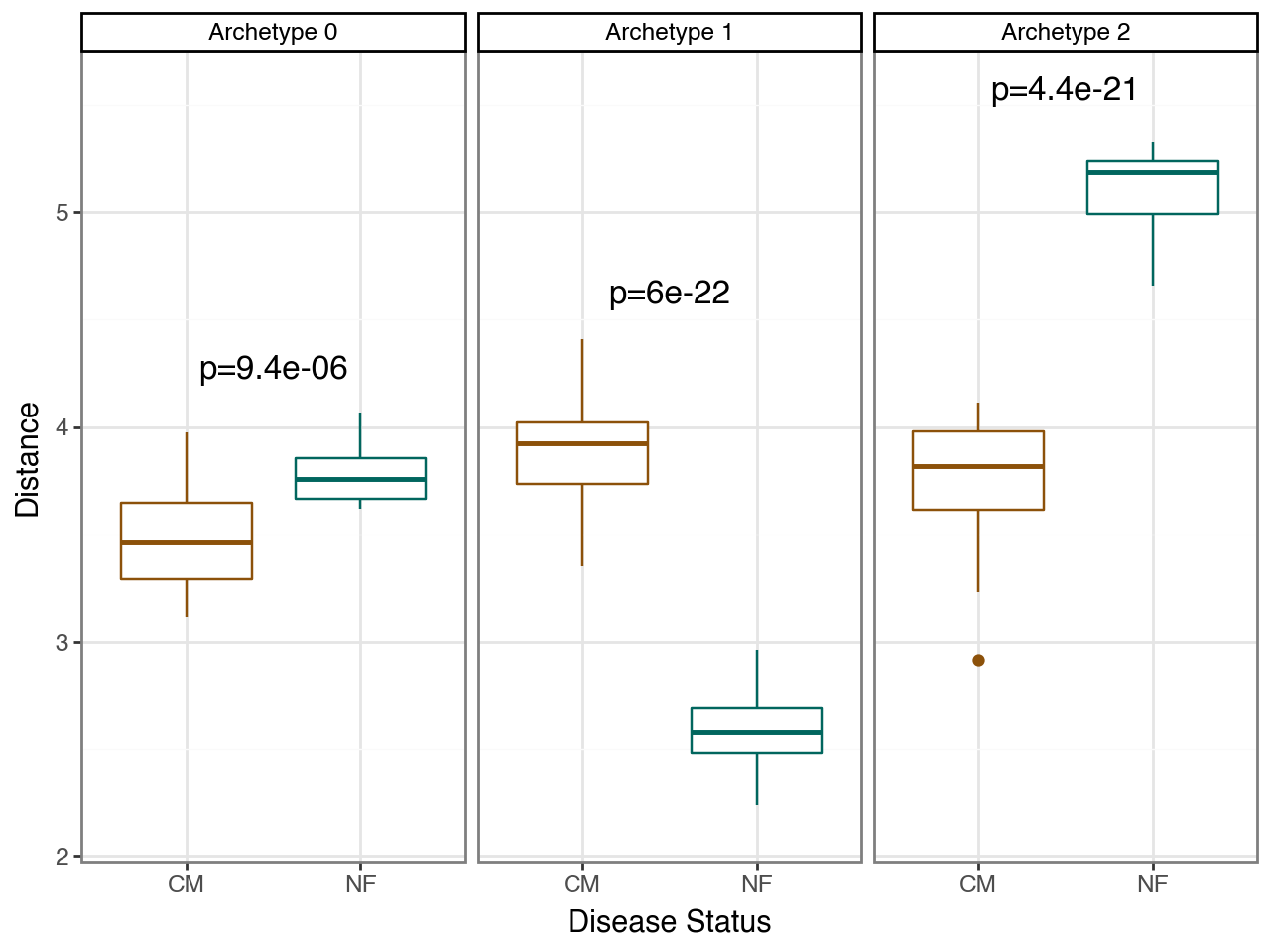
This analysis shows that distances to all three archetypes differed significantly between conditions. The strongest differences were observed for archetype 1, which was closer to NF donors, and archetype 2, which was closer to CM donors, whereas shifts along archetype 0 were comparatively less pronounced.
The key question, however, is whether archetype 2 represents a CM-specific state or rather a task that is already present in healthy tissue but becomes expanded in disease. To address this, we examined cell-level assignments by (i) assigning each fibroblast to its dominant archetype (the archetype with maximum weight) and (ii) quantifying, for each donor, the number and fraction of cells whose dominant archetype is 2. We then visualize these counts across NF donors.
archetype_oi = 2

aa_out = pt.get_aa_result(adata, n_archetypes=3)
adata.obs["archetype_max_weight"] = aa_out["A"].argmax(axis=1)
del aa_out
df = (
    adata.obs.value_counts(["disease", "donor_id", "archetype_max_weight"])
    .reset_index()
    .query(f"archetype_max_weight=={archetype_oi}")
    .join(
        adata.obs.value_counts("donor_id").reset_index().rename(columns={"count": "total_cells"}).set_index("donor_id"),
        on="donor_id",
    )
)
df["fraction"] = df["count"] / df["total_cells"]

df_nf = df.query("disease=='NF'").copy()
df_nf = df_nf.sort_values("count", ascending=False)
df_nf["donor_id"] = pd.Categorical(
    df_nf["donor_id"],
    categories=df_nf["donor_id"],
    ordered=True,
)

order = df_nf.sort_values("count", ascending=False)["donor_id"].tolist()

p = (
    pn.ggplot(df_nf)
    + pn.geom_col(pn.aes(x="donor_id", y="count", fill="fraction"), width=0.60, color="black")
    + pn.scale_x_discrete(limits=order[::-1])  # reverse so largest ends up on top after coord_flip
    + pn.coord_flip()
    + pn.theme_bw()
    + pn.labs(
        x="Donor ID (only NF)",
        y="Number of Cells Closest to Archetype 1",
        fill="Fraction of\nCells Closest\nto Archetype 1",
    )
    + pn.scale_fill_gradient2(
        low="#f7fbff",  # very light
        high="#2d8b2a",  # dark
        limits=(0, df_nf["fraction"].max()),
        oob=squish,
    )
    + pn.theme(
        figure_size=(5, 5),
    )
)
p.show()
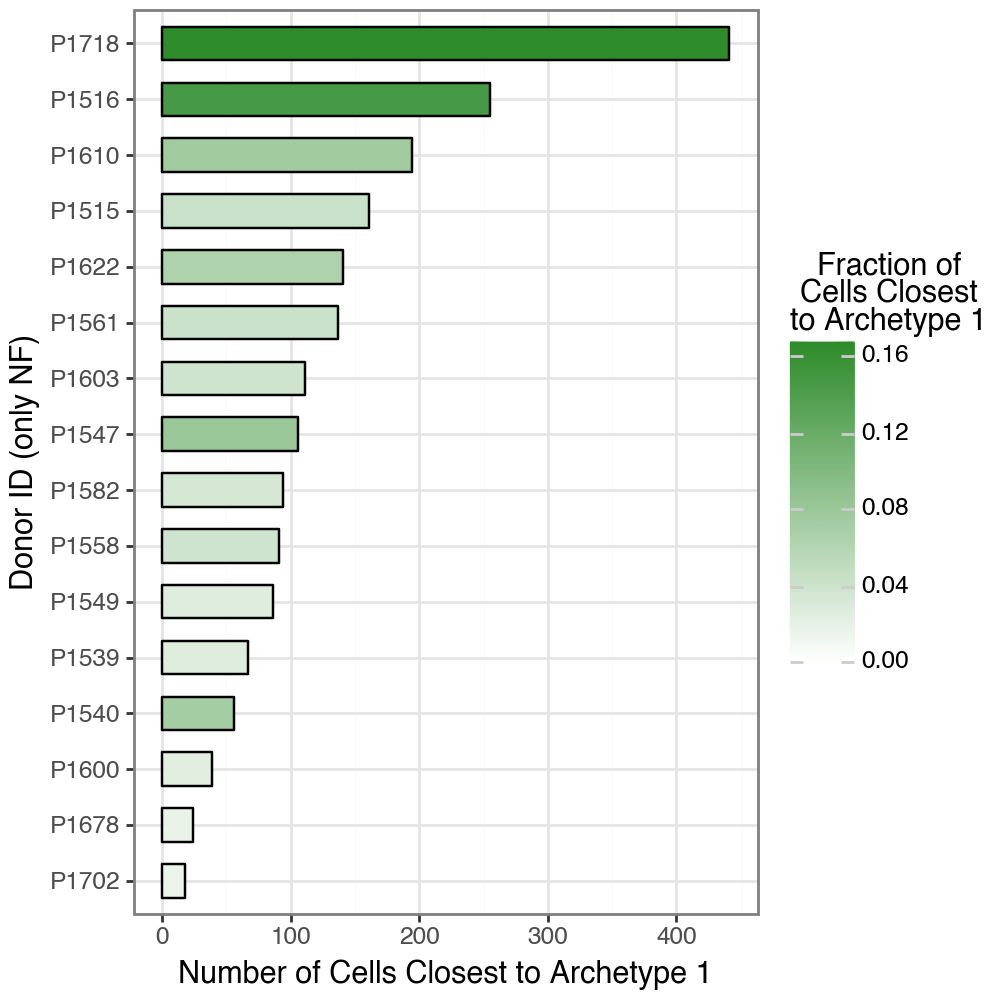
This shows that the enrichment of archetype 2 in CM does not imply disease exclusivity. Although CM donors were, on average, closer to archetype 2, every NF donor also contained a subset of fibroblasts whose dominant archetype assignment was archetype 2 (median \(\approx 115\) cells per donor), as quantified in the code chunk below. Thus, archetype 2 represents a task that is already present at low frequency in healthy tissue and becomes expanded in cardiomyopathy, rather than a state that emerges de novo in disease.
Characterizing the Archetypes#
To interpret the inferred archetypes, we examine their characteristic gene-expression profiles.
Following the definition in the Supplementary Methods (Section Archetype Characterization), each archetype is associated with a smooth kernel-based weighting over cells in latent space. These weights are then used to compute a weighted average of gene expression, yielding an archetype-level expression profile.
Concretely, for each archetype \(k\), this results in a vector $\( \boldsymbol{\mu}_k \in \mathbb{R}^{G}, \)\( where \)\mu_{kg}\( reflects the expression of gene \)g\( in cells proximal to archetype \)k$.
In practice, pt.compute_archetype_expression implements this procedure and returns a matrix (rows = archetypes, columns = genes).
For interpretation, we compute archetype-level expression using:
log1p-normalized expression (for interpretability in original scale), and
z-scored log1p expression (to highlight genes that distinguish archetypes).
We then reshape the resulting tables into long format for downstream ranking and visualization.
arch_expr = {
    "log1p": pt.compute_archetype_expression(adata=adata, layer=None),  # assumes log1p in .X
    "z_scaled": pt.compute_archetype_expression(adata=adata, layer="z_scaled"),
}

long_parts = []
for scale, df_wide in arch_expr.items():
    part = (
        df_wide.rename_axis(index="archetype")
        .reset_index()
        .melt(id_vars="archetype", var_name="gene", value_name="value")
    )
    part["scale"] = scale
    long_parts.append(part)

arch_expr_long = pd.concat(long_parts, ignore_index=True)

arch_expr_long = arch_expr_long.pivot_table(values="value", index=["archetype", "gene"], columns="scale").reset_index()
arch_expr_long.columns.name = None
arch_expr_long
| archetype | gene | log1p | z_scaled | |
|---|---|---|---|---|
| 0 | 0 | A1BG | 0.008323 | 0.001589 |
| 1 | 0 | A1BG-AS1 | 0.008030 | 0.000919 |
| 2 | 0 | A2M | 0.059264 | -0.024404 |
| 3 | 0 | A2M-AS1 | 0.001234 | -0.023568 |
| 4 | 0 | A2ML1 | 0.006310 | -0.008529 |
| ... | ... | ... | ... | ... |
| 56593 | 2 | ZXDC | 0.116283 | -0.003689 |
| 56594 | 2 | ZYG11A | 0.002587 | -0.018075 |
| 56595 | 2 | ZYG11B | 0.092547 | 0.007388 |
| 56596 | 2 | ZYX | 0.027687 | 0.018648 |
| 56597 | 2 | ZZEF1 | 0.138918 | 0.013749 |
56598 rows × 4 columns
Let’s print the top 10 genes per archetype.
for arch_idx in range(n_archetypes):
    display(arch_expr_long.query(f"archetype=={arch_idx}").sort_values("z_scaled", ascending=False).head(10).round(2))
| archetype | gene | log1p | z_scaled | |
|---|---|---|---|---|
| 2557 | 0 | ACSM3 | 1.50 | 0.58 |
| 14879 | 0 | SCN7A | 1.48 | 0.56 |
| 16685 | 0 | TLL2 | 0.46 | 0.38 |
| 2556 | 0 | ACSM1 | 0.44 | 0.38 |
| 16618 | 0 | THUMPD1 | 0.46 | 0.37 |
| 15637 | 0 | SMOC2 | 0.85 | 0.31 |
| 2598 | 0 | ADAM19 | 0.32 | 0.29 |
| 9242 | 0 | IL1RAPL1 | 0.62 | 0.27 |
| 6154 | 0 | COL15A1 | 0.75 | 0.26 |
| 9586 | 0 | KCNMB2 | 0.29 | 0.24 |
| archetype | gene | log1p | z_scaled | |
|---|---|---|---|---|
| 28399 | 1 | KAZN | 1.00 | 0.58 |
| 32789 | 1 | PXDNL | 0.42 | 0.33 |
| 30893 | 1 | NEAT1 | 1.71 | 0.33 |
| 26778 | 1 | FGF7 | 0.24 | 0.31 |
| 22310 | 1 | AL357873.1 | 0.17 | 0.31 |
| 30909 | 1 | NEGR1 | 1.63 | 0.30 |
| 30165 | 1 | MGST1 | 0.44 | 0.30 |
| 24705 | 1 | CFD | 0.34 | 0.30 |
| 28400 | 1 | KAZN-AS1 | 0.12 | 0.29 |
| 29669 | 1 | LSAMP | 0.23 | 0.27 |
| archetype | gene | log1p | z_scaled | |
|---|---|---|---|---|
| 51163 | 2 | POSTN | 0.72 | 0.76 |
| 45638 | 2 | FGF14 | 1.14 | 0.69 |
| 54324 | 2 | THBS4 | 0.64 | 0.64 |
| 45383 | 2 | FAM155A | 0.43 | 0.57 |
| 50422 | 2 | PALLD | 0.46 | 0.49 |
| 38609 | 2 | AC012636.1 | 0.24 | 0.46 |
| 47239 | 2 | KALRN | 0.41 | 0.45 |
| 47659 | 2 | LDLRAD4 | 0.57 | 0.44 |
| 53197 | 2 | SLC44A5 | 0.18 | 0.41 |
| 43895 | 2 | COL22A1 | 0.14 | 0.40 |
When inspecting the top-ranked genes per archetype, some markers may be immediately interpretable from domain knowledge. For example, POSTN and FAP are well-known marker of activated myofibroblasts. However, many other genes are less familiar, and in general it is difficult to infer a coherent biological program from long gene lists alone.
A common strategy is therefore to incorporate prior knowledge by testing whether each archetype is enriched for curated gene sets (pathways, signatures, or functional modules). This shifts interpretation from individual genes to higher-level processes.
Here, we first focus on ECM / matrisome-related gene sets from MSigDB (the NABA collection), while excluding cancer-specific matrisome sets since our data are not from a cancer context.
msigdb_raw = dc.op.resource("MSigDB")
msigdb_raw = msigdb_raw[~msigdb_raw.duplicated(["geneset", "genesymbol"])].copy()

naba_cancer_sets = [
    "NABA_MATRISOME_PRIMARY_METASTATIC_COLORECTAL_TUMOR",
    "NABA_MATRISOME_HIGHLY_METASTATIC_BREAST_CANCER",
    "NABA_MATRISOME_HIGHLY_METASTATIC_BREAST_CANCER_TUMOR_CELL_DERIVED",
    "NABA_MATRISOME_POORLY_METASTATIC_BREAST_CANCER",
    "NABA_MATRISOME_POORLY_METASTATIC_BREAST_CANCER_TUMOR_CELL_DERIVED",
    "NABA_MATRISOME_HIGHLY_METASTATIC_MELANOMA",
    "NABA_MATRISOME_HIGHLY_METASTATIC_MELANOMA_TUMOR_CELL_DERIVED",
    "NABA_MATRISOME_POORLY_METASTATIC_MELANOMA",
    "NABA_MATRISOME_POORLY_METASTATIC_MELANOMA_TUMOR_CELL_DERIVED",
    "NABA_MATRISOME_METASTATIC_COLORECTAL_LIVER_METASTASIS",
    "NABA_MATRISOME_HGSOC_OMENTAL_METASTASIS",
    "NABA_MATRISOME_MULTIPLE_MYELOMA",
]

matrisome = msigdb_raw.loc[msigdb_raw["geneset"].str.startswith("NABA_"), :].copy()
matrisome = matrisome.loc[~matrisome["geneset"].isin(naba_cancer_sets), :].copy()
matrisome = matrisome.rename(columns={"geneset": "source", "genesymbol": "target"})
matrisome_acts_ulm_est, matrisome_acts_ulm_est_p = dc.mt.ulm(
    data=arch_expr["z_scaled"],
    net=matrisome,
    verbose=False,
)

df_t = matrisome_acts_ulm_est.reset_index(names="archetype").melt(
    id_vars="archetype", var_name="matrisome_set", value_name="t_value"
)
df_p = matrisome_acts_ulm_est_p.reset_index(names="archetype").melt(
    id_vars="archetype", var_name="matrisome_set", value_name="p_value"
)

matrisome_df = df_t.merge(df_p, on=["archetype", "matrisome_set"], how="inner")
del df_t, df_p

plot_df = matrisome_df.copy()
arch_order = [f"{idx}" for idx in range(n_archetypes)]
plot_df["archetype"] = pd.Categorical(plot_df["archetype"], categories=arch_order, ordered=True)

wide = plot_df.pivot(index="archetype", columns="matrisome_set", values="t_value")
wide = wide.loc[arch_order, :]

# Data-driven ordering by clustering matrisome gene sets (optimal leaf ordering)
col_linkage = sch.linkage(
    pdist(wide.T, metric="euclidean"),
    method="average",
    optimal_ordering=True,
)
matrisome_order = wide.columns[sch.leaves_list(col_linkage)].tolist()
matrisome_order = [s.replace("NABA_", "") for s in matrisome_order]
plot_df["matrisome_set"] = plot_df["matrisome_set"].str.replace("NABA_", "")
plot_df["matrisome_set"] = pd.Categorical(plot_df["matrisome_set"], categories=matrisome_order, ordered=True)

p_sig = 0.05
sig_df = plot_df.loc[plot_df["p_value"] <= p_sig].copy()

p = (
    pn.ggplot(plot_df, pn.aes(y="matrisome_set", x="archetype", fill="t_value"))
    + pn.geom_tile()
    + pn.geom_text(
        data=sig_df,
        mapping=pn.aes(y="matrisome_set", x="archetype"),
        label="x",
        size=8,
        color="black",
    )
    + pn.scale_fill_gradient2(
        low="#2166AC",
        mid="#FFFFFF",
        high="#B2182B",
        midpoint=0,
        oob=squish,
    )
    + pn.theme_bw()
    + pn.theme(figure_size=(5, 5))
    + pn.labs(y="Gene", x="Archetype", fill="Matrisome Terms\nt-value")
)
p.show()
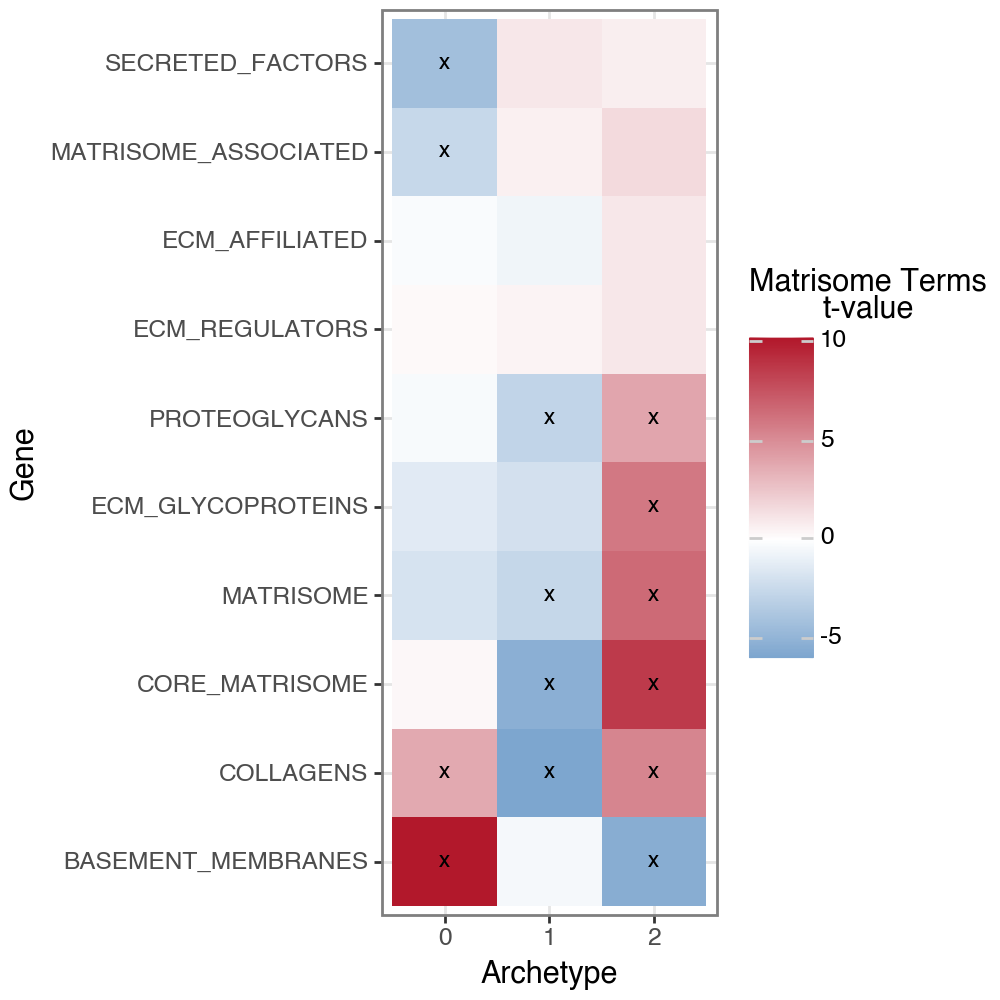
At the pathway level, archetype2 shows strong enrichment for MSigDB NABA Matrisome gene sets, including Core Matrisome, Collagens, ECM Glycoproteins, and Proteoglycans, indicating broad extracellular matrix production and remodeling, supporting the interpretation of archetype 2 as an activated, matrix-producing myofibroblast program.
In contrast, archetype 0 was enriched for NABA gene sets associated with Basement Membranes and ECM-affiliated proteins, consistent with a more structural and niche-supporting fibroblast state. This pattern suggests a role in maintaining tissue architecture rather than active fibrotic remodeling.
Beyond marker genes and pathway footprints, we can further characterize each archetype in terms of transcription factor (TF) activity.
To this end, we use CollecTRI regulons and estimate TF activities using decoupler’s univariate linear model (ULM) on the archetype-level z-scored expression profiles. For each archetype–TF pair, this yields a signed t-value (reflecting activation or repression strength) and an associated p-value.
We focus on a curated set of biologically relevant TFs (including regulators linked to fibrosis, stress response, and mechanotransduction) and visualize their activities in a heatmap, marking significant archetype–TF associations.
tf_list = [
    "TWIST1",
    "SCX",
    "KAT6A",
    "KDM2A",
    "PRRX1",
    "SRF",
    "NR3C1",
    "HIF1A",
    "NFKB",
    "CEBPB",
    "MYC",
    "NFE2L2",
    "PBX2",
    "LHX3",
    "HDAC3",
    "REST",
    "KLF17",
    "ERF",
]

collectri = dc.op.collectri(organism="human")
collectri_acts_ulm_est, collectri_acts_ulm_est_p = dc.mt.ulm(
    data=arch_expr["z_scaled"], net=collectri, verbose=False
)

df_1 = collectri_acts_ulm_est.reset_index(names="archetype").melt(
    id_vars="archetype", var_name="TF", value_name="t_value"
)
df_2 = collectri_acts_ulm_est_p.reset_index(names="archetype").melt(
    id_vars="archetype", var_name="TF", value_name="p_value"
)
collectri_df = df_1.join(df_2.set_index(["archetype", "TF"]), on=["archetype", "TF"])
del df_1, df_2

# save top 15 TFs per archetype
pval_thresh = 0.05
top_n = 15
df_filt = collectri_df[collectri_df["p_value"] <= pval_thresh].copy()

plot_df = collectri_df
plot_df = plot_df.loc[plot_df["TF"].isin(tf_list), :].copy()
plot_df["TF"] = pd.Categorical(plot_df["TF"], categories=tf_list, ordered=True)
arch_order = [f"{idx}" for idx in range(n_archetypes)]
plot_df["archetype"] = pd.Categorical(
    plot_df["archetype"], categories=arch_order, ordered=True
)
p_sig = 0.05
sig_df = plot_df.loc[plot_df["p_value"] <= p_sig].copy()
p = (
    pn.ggplot(plot_df, pn.aes(y="TF", x="archetype", fill="t_value"))
    + pn.geom_tile()
    + pn.geom_text(
        data=sig_df,
        mapping=pn.aes(y="TF", x="archetype"),
        label="x",
        size=8,
        color="black",
    )
    + pn.scale_fill_gradient2(
        low="#2166AC",
        mid="#FFFFFF",
        high="#B2182B",
        midpoint=0,
        oob=squish,
    )
    + pn.theme_bw()
    + pn.theme(
        figure_size=(3, 8),
    )
    + pn.labs(y="TF", x="Archetype", fill="TF Activation\nt-value")
)
p.show()
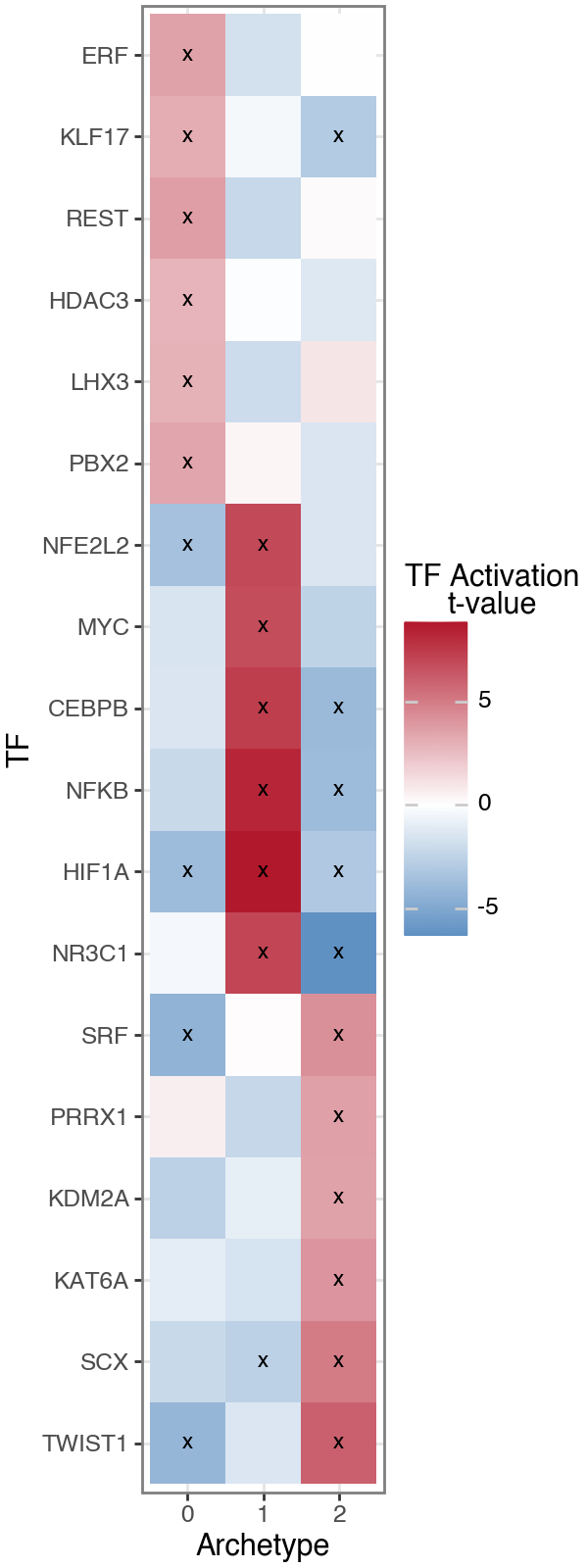
This reveals regulatory programs that closely mirror the gene- and pathway-level interpretations.
Archetype 1 is characterized by increased activity of NFKB, HIF1A, CEBPB, NR3C1, and NFE2L2, consistent with inflammatory, hypoxic, and oxidative stress signaling and supporting its interpretation as a stress-responsive fibroblast state.
In contrast, the fibrotic archetype shows strong activation of mesenchymal and mechanotransduction-associated TFs, including TWIST1, SCX, PRRX1, and SRF, consistent with an activated myofibroblast program.
The structural / basement membrane–associated archetype displays comparatively limited activation of profibrotic regulators, supporting its role as a niche-supporting fibroblast state rather than an actively remodeling program.
Conclusion#
In conclusion, this analysis demonstrates how ParTIpy enables a continuous and statistically rigorous framework for cross-condition comparisons in single-cell data. Rather than discretizing fibroblasts into clusters with sharp boundaries, we modeled them as mixtures of archetypal transcriptional programs and quantified condition-dependent shifts directly within task space.
Applied to ~147,000 human cardiac fibroblasts, this approach revealed a robust three-archetype structure corresponding to:
(0) a basement membrane–associated, niche-supporting structural program
(1) a quiescent yet stress-responsive program enriched in non-failing hearts
(2) an activated fibrotic / matrifibrocyte-like program enriched in cardiomyopathy
Donor-level aggregation and formal statistical testing showed significant shifts in proximity to all three archetypes between conditions, with the strongest redistribution occurring from the stress-responsive state toward the activated fibrotic program in cardiomyopathy. Importantly, the activated program was not disease-specific but present at low frequency in non-failing hearts, indicating quantitative reallocation among shared programs rather than the emergence of a novel pathological state.
Biologically, this framework integrates geometric structure in latent space with transcription factor and pathway-level interpretation, linking low-dimensional task allocation to extracellular matrix remodeling, mechanotransduction, and stress-response programs. Methodologically, it illustrates how archetypal analysis provides an interpretable, reproducible, and scalable alternative to cluster-based differential abundance testing for cross-condition single-cell studies.
Appendix#
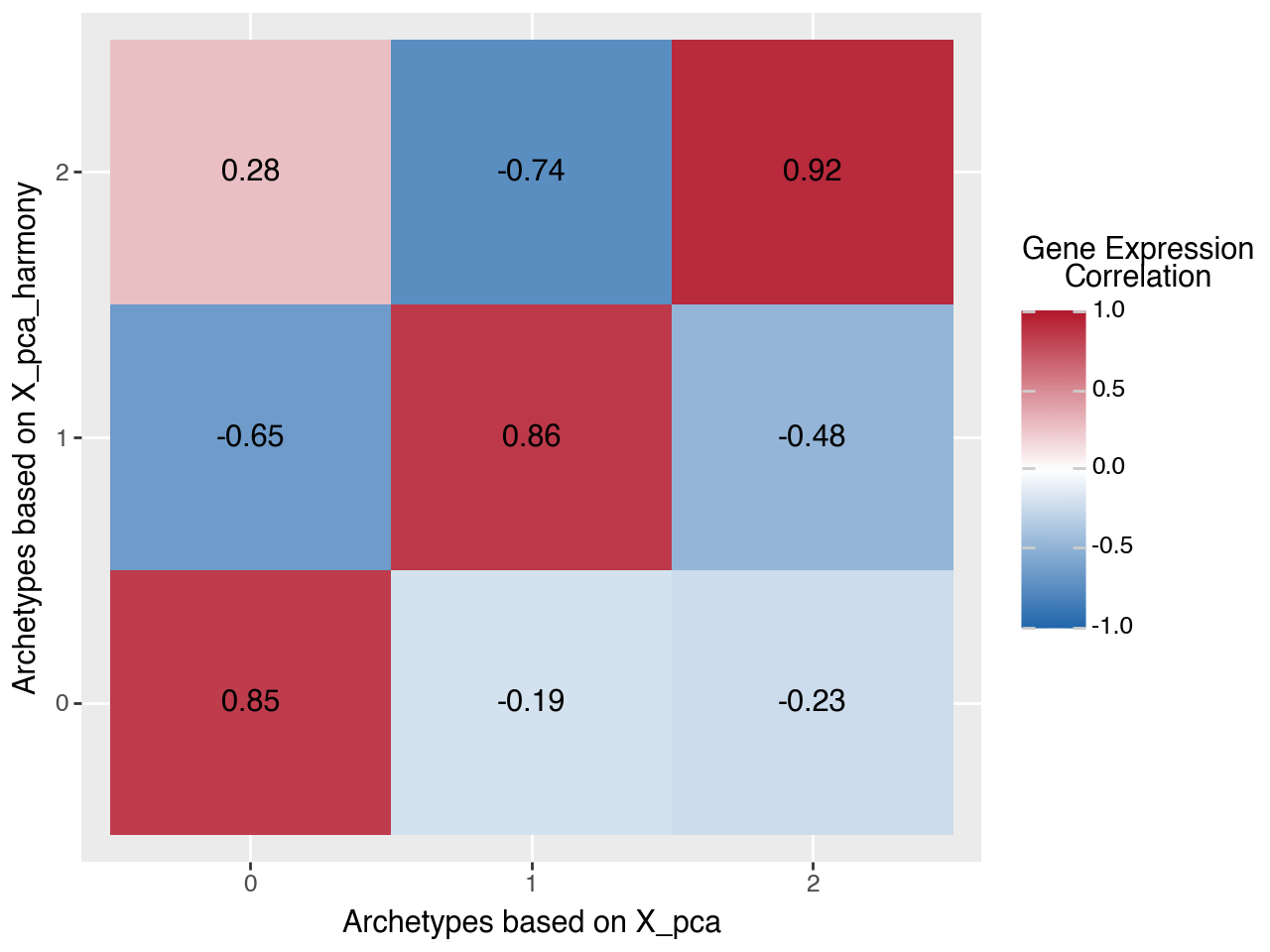
One sanity check is whether we recover the same archetypal programs when fitting AA on the Harmony-corrected PCA coordinates versus the original PCA embedding. Since archetype labels are only identifiable up to permutation, we (i) compute the characteristic gene expression per archetype (in both runs), (ii) align archetypes by solving a minimum-distance assignment problem, and (iii) quantify agreement by per-archetype Pearson correlation.
def pearsonr_per_row(mtx_1: np.ndarray, mtx_2: np.ndarray, return_pval: bool = False):  # noqa
    from scipy.stats import pearsonr

    assert mtx_1.shape == mtx_2.shape
    corr_list = []
    pval_list = []
    for row_idx in range(mtx_1.shape[0]):
        pearson_out = pearsonr(mtx_1[row_idx, :], mtx_2[row_idx, :])
        corr_list.append(pearson_out.statistic)
        pval_list.append(pearson_out.pvalue)
    if return_pval:
        return np.array(corr_list), np.array(pval_list)
    else:
        return np.array(corr_list)

# save memory and clean adata object
uns_keys_to_delete = [
    "AA_results",
    "AA_config",
    "AA_bootstrap",
    "AA_cell_weights",
    "AA_selection_metrics",
]
for k in uns_keys_to_delete:
    if k in adata.uns:
        del adata.uns[k]
del adata.layers["z_scaled"]

n_archetypes_test = 3

# compute AA based on original corrected PCA coordinates
adata_default = adata.copy()
pt.set_obsm(adata=adata_default, obsm_key="X_pca", n_dimensions=16)
pt.compute_archetypes(adata_default, n_archetypes=n_archetypes_test)
pt.compute_archetype_weights(
    adata_default,
    result_filters={"n_archetypes": n_archetypes_test, "obsm_key": "X_pca"},
)
weights = pt.get_aa_cell_weights(adata_default, n_archetypes=n_archetypes_test, obsm_key="X_pca")
assert np.allclose(weights.sum(axis=0), 1, rtol=1e-3)
adata_default.layers["z_scaled"] = sc.pp.scale(adata_default.X, max_value=10).astype(np.float32)
archetype_expression_default = pt.compute_archetype_expression(
    adata=adata_default,
    layer="z_scaled",
    result_filters={"n_archetypes": n_archetypes_test},
)
del adata_default

# compute AA based on harmony corrected PCA coordinates
adata_harmony = adata.copy()
pt.set_obsm(adata=adata_harmony, obsm_key="X_pca_harmony", n_dimensions=16)
pt.compute_archetypes(adata_harmony, n_archetypes=n_archetypes_test)
pt.compute_archetype_weights(
    adata_harmony,
    result_filters={"n_archetypes": n_archetypes_test, "obsm_key": "X_pca_harmony"},
)
weights = pt.get_aa_cell_weights(adata_harmony, n_archetypes=n_archetypes_test, obsm_key="X_pca_harmony")
assert np.allclose(weights.sum(axis=0), 1, rtol=1e-3)
adata_harmony.layers["z_scaled"] = sc.pp.scale(adata_harmony.X, max_value=10).astype(np.float32)
archetype_expression_harmony = pt.compute_archetype_expression(
    adata=adata_harmony,
    layer="z_scaled",
    result_filters={"n_archetypes": n_archetypes_test},
)
del adata_harmony

dist = cdist(archetype_expression_default, archetype_expression_harmony, metric="correlation")
corr = 1 - dist
_ref_idx, query_idx = linear_sum_assignment(dist)

archetype_expression_aligned_a = archetype_expression_default.loc[_ref_idx, :].to_numpy().copy()
archetype_expression_aligned_b = archetype_expression_harmony.loc[query_idx, :].to_numpy().copy()

pearson_r, pearson_pvals = pearsonr_per_row(
    archetype_expression_aligned_a, archetype_expression_aligned_b, return_pval=True
)

plot_df = (
    pd.DataFrame(
        corr[:, query_idx],
        index=[f"{idx}" for idx in range(n_archetypes_test)],
        columns=[f"{idx}" for idx in range(n_archetypes_test)],
    )
    .reset_index(names="x")
    .melt(id_vars="x", var_name="y", value_name="correlation")
)
p = (
    pn.ggplot(plot_df)
    + pn.geom_tile(pn.aes(x="x", y="y", fill="correlation"))
    + pn.geom_text(pn.aes(x="x", y="y", label="correlation"), format_string="{:.2f}")
    + pn.scale_fill_gradient2(
        low="#2166AC",
        mid="#FFFFFF",
        high="#B2182B",
        midpoint=0,
        limits=(-1.0, 1.0),
        oob=squish,
    )
    + pn.labs(
        x="Archetypes based on X_pca",
        y="Archetypes based on X_pca_harmony",
        fill="Gene Expression\nCorrelation",
    )
)
p.show()
Applied length scale is 2.07.
Applied length scale is 1.86.
Session Info#
import session_info2

print(session_info2.session_info(dependencies=True))
anndata	0.11.4
plotnine	0.14.5
scanpy	1.11.2
partipy	0.2.0 (0.0.1)
numpy	2.2.6
pandas	2.2.3
scipy	1.15.2
statsmodels	0.14.4
mizani	0.13.5
decoupler	2.0.6
----	----
llvmlite	0.44.0
requests	2.32.3
importlib_metadata	8.7.0
ipykernel	6.29.5
numcodecs	0.15.1
debugpy	1.8.14
narwhals	1.41.0
patsy	1.0.1
packaging	25.0
PyYAML	6.0.2
zstandard	0.25.0
tornado	6.5.1
decorator	5.2.1
Deprecated	1.2.18
kiwisolver	1.4.8
zarr	2.18.7
stack-data	0.6.3
pillow	11.2.1
prompt_toolkit	3.0.51
wrapt	1.17.2
xgboost	3.0.2
pyzmq	26.4.0
docrep	0.3.2
torch	2.10.0
jupyter_client	8.6.3
pure_eval	0.2.3
texttable	1.7.0
jupyter_core	5.8.1
matplotlib	3.10.3
python-dateutil	2.9.0.post0
marsilea	0.5.3
typing-inspection	0.4.2
crc32c	2.7.1
platformdirs	4.3.8
scikit-learn	1.6.1
natsort	8.4.0
pydantic_core	2.41.1
jedi	0.19.2
parso	0.8.4
annotated-types	0.7.0
wcwidth	0.2.13
pyarrow	20.0.0
certifi	2025.4.26 (2025.04.26)
ipython	9.2.0
urllib3	2.4.0
ipywidgets	8.1.7
seaborn	0.13.2
tqdm	4.67.1
pydantic	2.12.0
joblib	1.5.1
traitlets	5.14.3
asciitree	0.3.3
xarray	2024.11.0
threadpoolctl	3.6.0
igraph	0.11.8
comm	0.2.2
cloudpickle	3.1.1
legendkit	0.3.5
asttokens	3.0.0
dask	2024.11.2
numba	0.61.2
toolz	1.0.0
pytz	2025.2
six	1.17.0
h5py	3.13.0
typing_extensions	4.15.0
plotly	6.1.2
adjustText	1.3.0
appnope	0.1.4
coverage	7.10.7
MarkupSafe	3.0.3
legacy-api-wrap	1.4.1
Jinja2	3.1.6
Pygments	2.19.1
zipp	3.22.0
charset-normalizer	3.4.2
pyparsing	3.2.3
colorama	0.4.6
dcor	0.6
psutil	7.0.0
cycler	0.12.1
idna	3.10
session-info2	0.1.2
executing	2.2.0
setuptools	80.8.0
matplotlib-inline	0.1.7
----	----
Python	3.11.0 | packaged by conda-forge | (main, Jan 14 2023, 12:26:40) [Clang 14.0.6 ]
OS	macOS-15.7.1-arm64-arm-64bit
Updated	2026-02-16 21:32